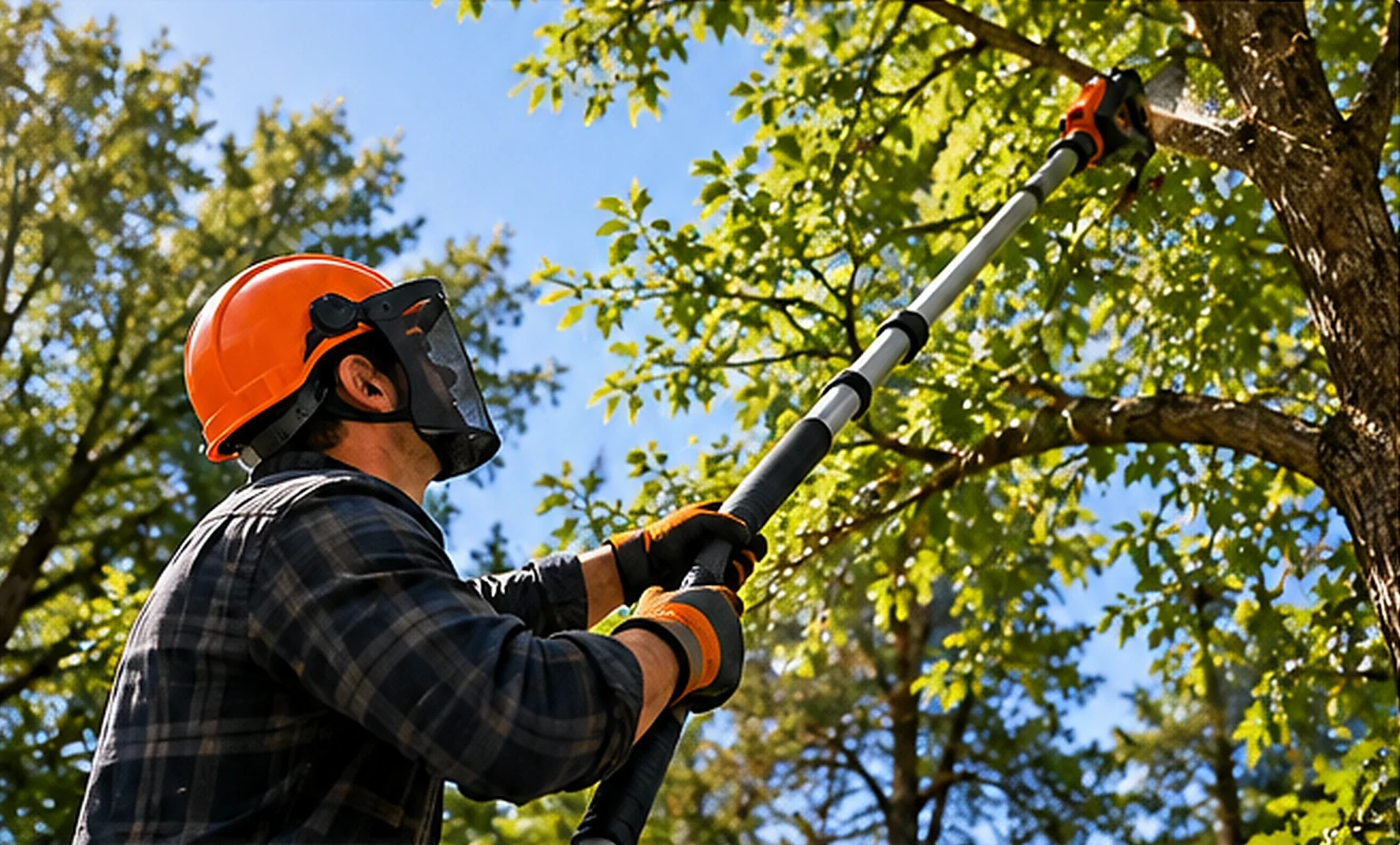
Pole saw types at a glance
The mistake is buying the biggest pole saw you can afford. A pole saw is a lever with a chainsaw hanging off the end. Physics does not care that the box says "professional."
| Type | Our editorial take | Best suited to | Main advantage | Main drawback |
|---|---|---|---|---|
| Battery | Best default for most homeowners | Intermittent pruning, residential yards, acreage with moderate work | Instant start, low engine maintenance, good ecosystem value | Battery cost, eventual battery replacement, weight varies dramatically |
| Manual | Smarter than many buyers assume | A few high branches, lighter pruning, maximum reach | Light, quiet, almost no power-system maintenance | Slow and physically demanding on larger branches |
| Corded electric | Rational but geographically challenged | Small yards with convenient outlets | Low purchase complexity, no fuel or battery aging | Extension cord restricts mobility and becomes another thing to manage |
| Gas | Still justified for genuinely heavy work | Long sessions, commercial work, remote properties | Fast refueling, established service path, sustained operation | Noise, fumes, fuel storage, engine maintenance, often substantial weight |
Manual pole saws remain legitimate tools rather than museum exhibits. Fiskars, for example, currently sells extendable manual models reaching 12 to 14 ft, while corded products such as the WEN CP0810 remain available with a 9 ft maximum pole length. Battery and gas systems span everything from light homeowner tools to professional telescoping machines.

Which type should you buy?
For ordinary homeowner pruning
We favor battery. Pole-saw work is usually intermittent - position the saw, make a short cut, lower it, move the branch, reposition. That operating pattern makes battery tools more practical than a chainsaw-style continuous-runtime comparison suggests. Owners discussing actual pole-saw use repeatedly describe convenience and start-stop operation as major advantages, although those reports are anecdotal rather than controlled testing.
If you already own suitable outdoor-power batteries
Start there. A very good pole saw using batteries and chargers already sitting in your garage may be a much better purchase than a theoretically superior standalone tool that requires another expensive battery platform. Battery lock-in is annoying, but pretending it does not exist does not make the batteries free.
If you need only a few high cuts
Look seriously at a manual pole saw. A powered cutting head adds weight exactly where you least want it. A manual saw can reach high branches without batteries, gasoline, a motor, or a gearbox at the far end of a long lever. Experienced users sometimes prefer manual saws specifically for extra reach and cleaner, more controlled pruning.
If you work for long periods, professionally, or far from charging
Gas still has a case. Quick refueling, an established small-engine service ecosystem, and decades of parts knowledge matter more when the tool earns money or must keep working all day. Battery equipment has become seriously capable, but "battery is always better now" is the sort of absolute statement people make shortly before discovering their job is the exception.
If your entire yard is within convenient extension-cord range
Corded electric is still perfectly rational. WEN's current CP0810, for example, uses an 8-amp motor, a 10-inch bar, and a pole that adjusts from 6.7 to 9 ft. The problem is not whether corded saws work. The problem is that trees have an irritating habit of growing wherever they want instead of next to outlets.
How we researched this guide
We did not physically test every pole saw discussed or independently benchmark cutting speed, runtime, vibration, or durability.
Hard specifications and safety instructions are based primarily on current manufacturer documentation and official support material. Manufacturer performance figures are described as manufacturer claims rather than independent test results.
Specialist forums and Reddit were used only to identify recurring ownership experiences and decision problems - including balance, fatigue, battery-platform lock-in, storage, full-extension handling, and long-term ownership concerns. Those discussions are anecdotal context, not proof of reliability, lifespan, cutting performance, or a universal user experience.
That distinction matters. A manufacturer can reliably tell you a tool's published dimensions. An owner can tell you that a tool feels like an anchor on a broomstick. Neither source should be asked to do the other's job. Where public evidence cannot establish a universal answer - especially long-term battery-versus-gas durability - we say so rather than manufacture certainty.
The buying rule that matters most
Choose by reach and fatigue first, power second.
Our selection order is:
- Required actual reach
- Typical branch diameter
- Workload and frequency
- Operating weight and balance
- Power source
- Pole design and stiffness
- Existing battery or attachment ecosystem
- Bar length
- Runtime or refueling requirements
- Maintenance
- Parts and serviceability
- Storage, transport, and total ownership cost
Most generic buying guides effectively reverse that order. They start with voltage, engine displacement, bar length, and maximum reach because those numbers fit neatly in tables. Unfortunately, your shoulders cannot read tables.
1. Start with actual reach, not advertised reach
"Reach" is one of the messiest specifications in this category because manufacturers do not always mean the same thing by it.
DEWALT says the DCPS620 pole itself extends to about 10 ft while advertising up to 15 ft of total reach. The company explicitly explains that the 15 ft figure is based on a 6 ft person holding the pole at shoulder level at 60 degrees, and that actual reach varies with the operator.
Milwaukee takes a more directly comparable approach on its M18 FUEL Telescoping Pole Saw, listing a 9 ft collapsed length and 13 ft fully extended length.
WEN provides both numbers for its corded CP0810: the pole adjusts from 6.7 to 9 ft, while the company describes the resulting overhead reach as up to 14 ft.
So when one box says "14 ft reach" and another says "13 ft extended," you may not be comparing a shorter saw with a longer one. You may be comparing marketing arithmetic with physical dimensions.
What to compare instead
- Minimum usable tool length
- Maximum physical tool length
- Manufacturer-stated working or overhead reach
- Number and type of extension sections required
Our editorial rule: Use physical tool length as the comparison baseline. Treat "working reach" as an estimate, not as the length of the machine.
Before buying, estimate the height of the actual branches you normally need to cut. Then compare that requirement with the tool's physical extension and its prescribed operating position. Do not buy several unnecessary feet "just in case." Every extra foot adds leverage against you.
Specialist users make the same point in less polite language. In one ArboristSite discussion, the advice was simply to think carefully about how much reach is really necessary because telescoping capability adds considerable weight.
2. Weight on the spec sheet tells only half the story
A pole saw's total weight matters. Its weight distribution often matters more.
Picture an 8 lb weight against your torso. Now put the same weight on the end of a 10 ft pole and hold it away from you. Congratulations, you have rediscovered leverage without having to sit through high-school physics.
| Weight factor | What it tells you |
|---|---|
| Operating weight | What the complete tool weighs with battery or fuel, bar, chain, and oil |
| Cutting-head weight | How much mass sits near the far end of the lever |
| Balance at working length | How controllable the complete tool feels at the extension you actually use |
Do not assume the lightest published weight automatically produces the easiest tool to handle.
One longtime TractorByNet user compared two gas pole pruners side by side and chose the nominally heavier ECHO because its balance made it feel lighter. The competing tool felt more head-heavy despite weighing less on paper. That is one person's experience, not laboratory evidence, but it illustrates exactly why total weight alone is inadequate.
The best test before buying
If a local dealer has the tool assembled, extend it to approximately the length you expect to use and hold it in a realistic working position for a few minutes.
Do not just lift it vertically for three seconds and announce that you're fine. Almost everyone is Hercules for three seconds.
- How quickly your forward arm tires
- Whether the cutting head wants to drop
- Whether you can move the bar precisely sideways
- How much the shaft flexes
- Whether the battery or engine counterbalances the head
- Whether you can lower the tool under control
This tells you more about usability than another hundred watts, another ten volts, or another inch of bar.
3. Choose branch capacity before bar length
Buy enough bar for the branches you normally cut. Stop there.
A longer bar is not automatically an upgrade because the additional bar, chain, and structure sit at the cutting end. That is the worst possible place to add unnecessary weight.
More importantly, bar length is not a universal branch-diameter rating.
DEWALT pairs an 8-inch bar with an intended cutting capacity of limbs up to 8 inches on the DCPS620. Sun Joe's current SWJ803E uses a 10-inch bar but lists 8.5 inches as its recommended maximum cutting thickness, despite publishing a 9.5-inch maximum figure. Different machines have different limitations.
Ignore internet formulas claiming that a particular bar length always equals a particular safe branch diameter. Check the manufacturer's stated cutting capacity for the exact model.
Our editorial rule: Buy the shortest bar that comfortably handles your normal branches.
If almost everything you cut is 2 to 4 inches, buying a much larger cutting head because you might someday encounter a monster limb is poor optimization. You carry the extra mass on every ordinary cut.
And a bar physically capable of getting through a large suspended limb does not mean you should be standing underneath that limb cutting it from the ground. Cutting capacity and sensible working capacity are not the same thing.
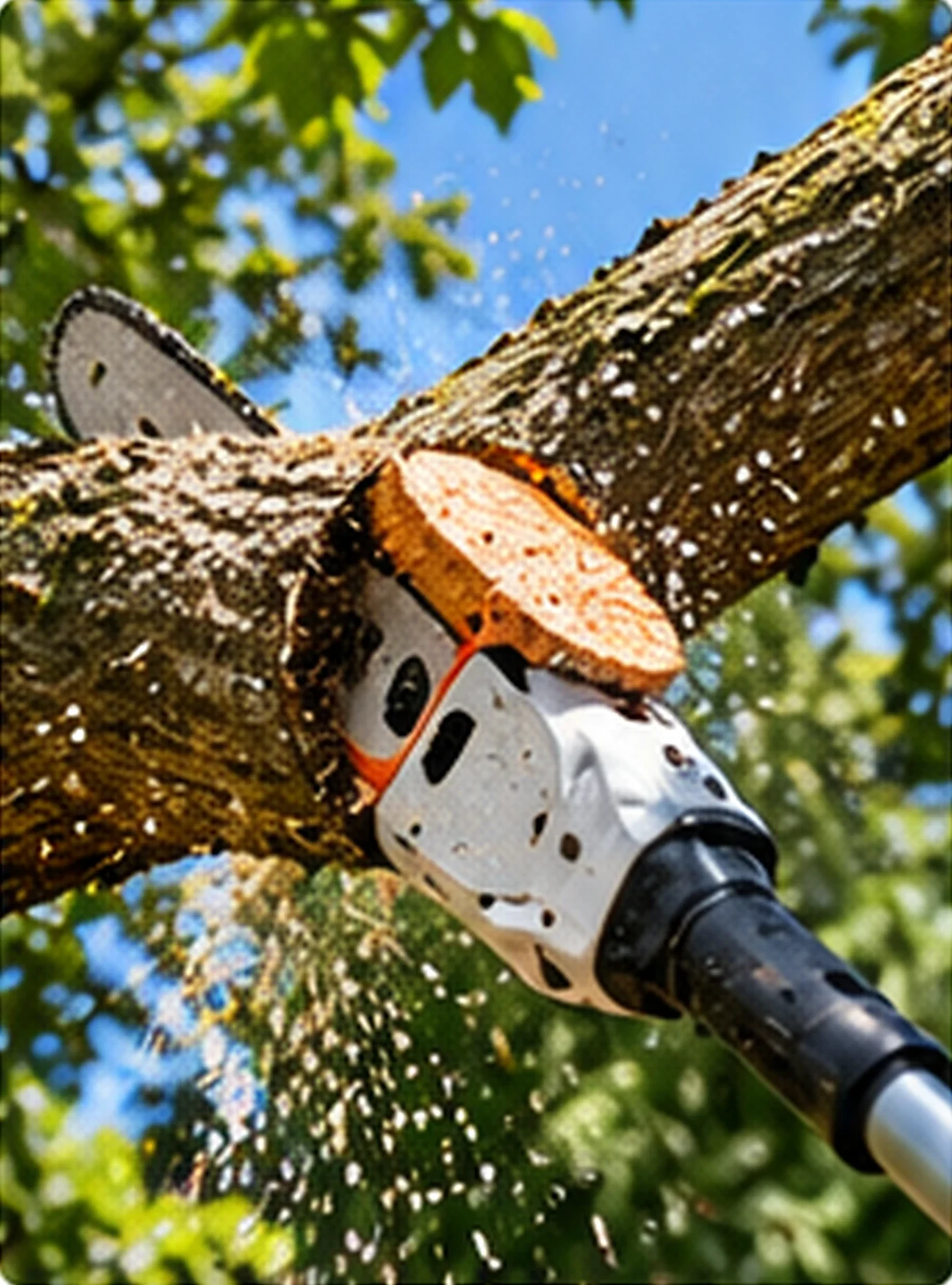
4. Match the power source to the way you actually work
The question is not "Is battery better than gas?"
The useful question is "Which power source creates the fewest problems for my workload?"
Manual pole saw
Choose manual when you have relatively few branches, value reach and low weight, and do not need powered cutting speed. A current Fiskars extendable saw-and-pruner model reaches 12 ft, while another extends to 14 ft. There is no battery to charge, fuel to store, carburetor to clean, motor to repair, or chain-oil tank to leak. The price is physical effort and slower cutting. For light occasional pruning, that may be a very good trade.
Corded electric pole saw
Choose corded when the work stays close to the house, outlets are convenient, and you want a powered chain without owning batteries or maintaining a gasoline engine. Corded tools still offer real cutting performance and relatively low tool weight. Their limitation is brutally obvious: the cord. If the cord will cross driveways, gardens, fences, wet areas, or half your property, the theoretical savings become less impressive.
Battery pole saw
Battery is our preferred starting point for most homeowners. The advantages fit pole-saw work unusually well: instant start, no gasoline storage, no carburetor, lower noise than gas, easy stop-start operation, and the ability to share batteries across an existing tool platform. The disadvantages are real too: expensive batteries, aging packs, weight, hard-to-compare runtime claims, and electronics that may be less field-repairable.
Gas pole saw
Choose gas when prolonged use, rapid refueling, dealer serviceability, or established long-term parts support outweigh the inconvenience. ECHO lists the PPT-2620 at 17.4 lb dry, with a 12-inch bar and a physical extended length of 145 inches, or a little over 12 ft. A shoulder harness is standard. If you prune four trees twice a year, buying commercial gas equipment because it feels "more durable" can leave you maintaining an engine that spends most of its life waiting for something to do.
Do not buy battery because "electric is the future." Buy it because the operating pattern fits your work.
Battery vs gas pole saw: which is actually better?
Our editorial answer: Battery is the better fit for most residential and intermittent pruning. Gas remains justified for sustained heavy or professional use, especially where fast refueling and conventional serviceability matter.
The reason is duty cycle.
A chainsaw may spend long periods cutting. Pole-saw work often consists of a short burst of cutting followed by repositioning, lowering the tool, clearing branches, and moving to the next cut.
A 2026 ArboristSite discussion describes that cycle almost comically well: position, lift, make a short cut, move, repeat. The owner reported that battery consumption was minor relative to the amount of time spent positioning the tool. That is anecdotal experience, but it explains why continuous chainsaw runtime is a poor proxy for ordinary pole-saw use.
Gas becomes more compelling as the duty cycle changes toward sustained cutting. A 2026 Reddit discussion among farm and professional users shows exactly that split: battery convenience was praised, while gas retained support for larger workloads, rapid refueling, and long-term ownership.
There is no contradiction. Different jobs produce different winners. Shocking, apparently.
5. If you choose battery, buy the ecosystem as much as the saw
The sticker price of a cordless bare tool is often fiction by omission.
The useful comparison is:
Tool using batteries you already own
versus
Tool + battery + charger + possible spare battery + future replacement batteries
If you already own compatible outdoor-power batteries, that can outweigh relatively small differences between otherwise competent pole saws.
Community discussions repeatedly frame cordless purchasing this way. Owners often begin with "I already have DeWalt," "I already have Makita," or "I'm already in this battery system" rather than asking which isolated saw wins a specification contest.
Do not buy by voltage alone
Battery voltage is useful platform information. It is not a universal performance score.
Motor design, battery discharge capability, controller limits, gearing, chain speed, chain condition, cutting geometry, and the specific battery pack all matter.
A 56V label does not automatically defeat an 18V or 20V-class product any more than engine displacement alone tells you whether a car is faster.
Compare the complete system and actual cutting claims, not the largest numeral printed on the battery.
6. Runtime specifications are often apples versus lumber
Manufacturers frequently publish "cuts per charge." Those figures can be useful inside a product line, but they become dangerous when treated as standardized tests.
DEWALT says the DCPS620 can make up to 96 cuts per charge in 4 x 4-inch pressure-treated pine using a specified DCB204 battery. ECHO publishes up to 200 cuts for the battery-powered DPPT-2600H with its 5.0Ah configuration. Those numbers are manufacturer claims using different tools and test conditions, so they should not be treated as a direct 96-versus-200 performance contest.
Ask instead:
Will one battery comfortably finish my normal pruning session?
- Which battery produced the published runtime
- Whether that battery is included
- Recharge time
- Cost and weight of a spare
- Whether larger packs change balance
- Whether your other tools use the same batteries
For occasional pruning, your arms may become the limiting factor before the battery. For several hours of serious cutting, battery logistics become a completely different problem.
7. Telescoping vs sectional pole saw
Pole construction changes far more than storage length.
| Telescoping pole | Sectional or split-shaft pole |
|---|---|
| Continuous or near-continuous length adjustment | Length changes in fixed sections |
| Convenient when branch heights vary constantly | Easy to remove unnecessary sections |
| Often optimized for longer working reach | Usually breaks down more compactly |
| Can become long even when collapsed | Easier vehicle and garage storage |
| Added telescoping hardware can add weight | Multiple joints can introduce flex |
| Common on dedicated long-reach tools | Common on attachment and homeowner systems |
Milwaukee's dedicated M18 FUEL telescoping pole saw runs from 9 ft collapsed to 13 ft extended. STIHL's battery HTA 50 instead uses a two-piece shaft specifically promoted for easier storage and transport, with an optional extension available.
Neither architecture is inherently superior.
Our editorial preference: Buy telescoping when variable reach and maximum extension matter more than storage. Buy sectional when transport, compact storage, and the ability to leave unnecessary length behind matter more.
And whatever you buy, investigate stiffness at full extension. A spectacular reach specification is less spectacular when the cutting head wobbles around like a fishing rod in a thunderstorm.
8. Dedicated pole saw vs attachment system
An attachment system makes sense when you genuinely want a system.
Milwaukee explicitly distinguishes its dedicated telescoping pole saw from its QUIK-LOK pole-saw configuration, while STIHL sells the HT-KM pole pruner as an attachment for its KombiSystem powerheads.
Choose a dedicated pole saw when:
- Pole pruning is the main job
- Maximum reach matters
- You do not need several other yard attachments
- You want fewer couplings and configuration decisions
Choose an attachment system when:
- You also need a trimmer, edger, hedge trimmer, cultivator, or similar attachments
- Storage space matters
- You prefer one powerhead
- You are already invested in that system
Do not buy six hypothetical future attachments to justify one attachment you need today. That's not versatility. That's retail therapy with a driveshaft.
9. Maintenance is part of the purchase
Every powered chain pole saw still has a cutting system that requires attention.
Battery does not mean "maintenance-free."
- Saw-chain tension
- Chain sharpening or replacement
- Guide-bar wear
- Bar-and-chain oil
- Sprocket wear
- Cleaning
- Fastener inspection
DEWALT's DCPS620 manual, for example, says to check chain tension regularly and notes that a new chain stretches during early use. The same manual instructs owners to empty the oil tank after cutting.
That last point matters because oil seepage is a recurring post-purchase complaint across chain-saw and pole-saw ownership. Sometimes the tool is defective. Sometimes an automatic-oiler system simply continues releasing residual oil or the manufacturer expects the tank to be drained for storage.
Check the manual before deciding your new saw is hemorrhaging internally.
Gas adds another maintenance layer
- Fuel mixture or fuel specification
- Fuel aging
- Carburetor and fuel-system concerns
- Spark plug
- Air filter
- Starting system
- Exhaust and spark-arrestor maintenance where applicable
ECHO's current Power Pruner storage instructions call for draining the fuel system during long-term storage and running the engine until remaining fuel is consumed.
If you use the saw constantly, that maintenance may be an acceptable cost of doing business.
If you use it twice a year, ask yourself whether what you really wanted was a pruning tool or a new small-engine hobby.
10. Durability and repairability are not the same thing
A durable tool can still be miserable to repair.
A repairable tool can still require too many repairs.
For expensive pole saws, investigate both separately.
- Replacement chain availability
- Replacement bar availability
- Battery availability
- Sprocket and wear-part availability
- Published parts diagrams
- Dealer or service-center access
- Warranty terms
- Whether the battery or electronics are separately replaceable
- Whether the product uses common or proprietary consumables
Long-term battery-versus-gas durability is one area where sweeping claims are not justified by good public evidence. Current owner discussions explicitly ask whether modern battery pole saws will remain viable for 10 to 15 years, but anecdotes cannot establish a universal lifespan.
So do not ask, "Will battery last 15 years?"
Ask, "If something fails in year seven, what can I still buy and who can repair it?"
That question has an answer you can investigate before handing over money.
11. Storage and transport deserve a line on your checklist
Some long pole saws are wonderfully convenient until the job is over.
Milwaukee's dedicated telescoping model, for example, is still 9 ft long when collapsed. STIHL specifically promotes the split-shaft design of the HTA 50 for easier storage and transport.
Measure your:
- Garage wall
- Shed
- Pickup bed
- SUV cargo area
- Trailer
- Tool rack
before buying.
If the saw cannot fit where you need to store or transport it, that is not a minor inconvenience. It is a specification failure you discovered after paying for it.
12. Do you even need a powered pole saw?
Sometimes no.
A manual pole saw deserves serious consideration when:
- You make only a few cuts per year
- Branches are relatively modest
- Maximum reach matters more than cutting speed
- You want low tool weight
- You do not want another battery platform
- You do not want another gasoline engine
- Quiet operation matters
A long-running ArboristSite discussion includes an experienced user concluding that a manual pole saw would cover roughly 90 percent of the work he had in mind while reaching higher and producing the controlled pruning he wanted. That is anecdotal, but it is an excellent reminder that "powered" and "better" are not synonyms.
Powered tools win when cutting volume or branch size makes manual sawing tedious.
For three branches? Spending hundreds of dollars to avoid several minutes of sawing deserves at least a moment of reflection.
13. Safety can eliminate a saw before specifications matter
Some situations should end the buying comparison entirely.

Power lines
Do not treat extra pole length as permission to work near electrical lines.
OSHA defines line-clearance tree trimming as tree work near energized power lines, including work within 10 ft under the applicable standard. Manufacturer requirements can be considerably more conservative. EGO's current telescoping pole-saw support instructions, for example, tell operators not to work within 15 m of overhead electrical lines.
The exact requirement for your equipment and situation comes from the tool manual, utility guidance, and applicable regulations.
If a branch is near energized conductors, this is no longer a shopping problem.
Ladders
Do not buy extra reach and then combine the pole saw with a ladder because it still is not long enough.
DEWALT's pole-saw instructions explicitly warn against operating from a ladder or another unstable surface because loss of control can cause severe injury. EGO likewise states not to cut from a ladder and directs such operations to professionals.
If safe ground-based reach is insufficient, you have crossed the boundary of what a longer homeowner pole saw is supposed to solve.
Falling branches
Do not stand directly underneath the limb.
Current EGO guidance warns that branches can fall unpredictably and recommends positioning the saw at an angle of 60 degrees or less for typical pruning.
A powered chain is only one hazard. The several-hundred-pound object you have just persuaded to obey gravity is another.
What matters most when choosing a pole saw
| Priority | Buying criterion | The useful question |
|---|---|---|
| 1 | Actual reach | Can the physical tool reach my normal cut points from safe footing? |
| 2 | Branch size | What diameter do I cut most often? |
| 3 | Workload | Five cuts, an afternoon, or continuous professional work? |
| 4 | Weight and balance | Can I actually control it fully extended? |
| 5 | Power source | Which system fits that workload with the least inconvenience? |
| 6 | Pole construction | Telescoping, sectional, fixed, or attachment-based? |
| 7 | Stiffness | Does the tool remain controllable at the required length? |
| 8 | Existing ecosystem | Do I already own compatible batteries or a powerhead? |
| 9 | Bar and chain | Is the cutting system appropriate without unnecessary head weight? |
| 10 | Runtime or refueling | Can it finish a normal session without becoming logistical theater? |
| 11 | Maintenance and parts | Can I maintain and repair it without hunting discontinued parts? |
| 12 | Storage and cost | Where will it live, and what does the complete working system cost? |
Buying checklist
Before buying a pole saw, answer these questions with actual numbers where possible:
- What is the highest branch I regularly need to cut?
- What is the tool's physical maximum length?
- Does the advertised "reach" include the operator?
- What does the complete tool weigh ready to work?
- Where are the motor and gearbox located?
- How does the tool balance at full extension?
- What branch diameter do I normally cut?
- What maximum cutting diameter does the manufacturer actually specify?
- Can I remove an extension for lower work?
- How stiff is the pole at maximum length?
- Do I already own compatible batteries or a powerhead?
- What battery was used for the published runtime claim?
- What does that battery weigh and cost?
- Is the battery included or is the advertised price tool-only?
- Does the saw use automatic chain lubrication?
- What does the manual say about draining oil for storage?
- How is chain tension adjusted?
- Are replacement chains and bars easy to obtain locally?
- Is a harness or strap available if the saw is heavy?
- How long is the tool when collapsed or disassembled?
- Will it fit in the vehicle and storage space you actually use?
- Is local service available?
- Would a manual pole saw do the job with less complexity?
- Does the job involve power lines, ladders, unstable footing, or branches too large to handle safely from the ground?
If you cannot answer the first six questions, you are not ready to compare brands yet.
Frequently asked questions
What size pole saw do I need?
Choose the shortest pole saw that safely reaches your normal branches and the smallest cutting system that comfortably handles their normal diameter. Extra reach and extra bar length impose weight and control penalties, so buying "more" is not automatically buying better.
How far can a pole saw reach?
There is no standard relationship between advertised reach and physical tool length. Some manufacturers publish actual extended length; others advertise a working-reach estimate that includes the operator. DEWALT, for example, describes a roughly 10 ft pole with up to 15 ft of total reach under a specified operator-height and holding-angle assumption.
Does advertised reach include my height?
Sometimes. Check the fine print. If the specification says "working reach," "overhead reach," or "total reach," determine whether operator height has been included. For meaningful model-to-model comparison, physical tool length is the cleaner number.
How thick a branch can a pole saw cut?
Use the exact manufacturer's stated capacity rather than assuming capacity solely from bar length. One 8-inch-bar pole saw may be rated for an 8-inch limb while another machine with a 10-inch bar may recommend something smaller. Larger suspended limbs also increase the difficulty and consequences of the cut.
Is an 8-inch, 10-inch, or 12-inch bar better?
The smallest bar that comfortably handles your ordinary branches is usually the smarter choice. A longer bar adds capacity but can also add cutting-head weight. Buying a 12-inch head for 2-inch branches is mostly a way to exercise your shoulders.
Is battery or gas better for a pole saw?
For most intermittent residential pruning, our editorial preference is battery. Gas becomes more attractive as work becomes longer, heavier, more remote, or professionally dependent on rapid refueling and conventional serviceability. Neither power source is universally superior.
Will one battery be enough?
Maybe, and that is more useful than pretending a universal runtime exists. Compare your normal pruning session with manufacturer test conditions. Published "cuts per charge" figures are often based on different batteries, branch sizes, materials, and test methods, so cross-brand comparisons require caution.
Does a bigger battery make a pole saw better?
Not automatically. More capacity may extend runtime and sometimes alter the tool's balance, but the larger pack also adds weight. Evaluate the complete tool at working length rather than treating amp-hours as free energy delivered by weightless magic.
Is a telescoping pole saw better than a sectional one?
Telescoping designs are better when continuous length adjustment and long working reach matter. Sectional designs are often easier to store and let you remove unnecessary length. The important hidden variable is stiffness and balance in the configuration you actually need.
Should I buy a dedicated pole saw or an attachment system?
Buy a dedicated pole saw if pruning is the main job and you value optimized reach and simplicity. Buy an attachment system if you genuinely expect to share one powerhead across several useful yard tools. Do not pay for theoretical versatility you will never use.
Is a manual pole saw still worth buying?
Yes. For a small number of high branches, a manual pole saw can be lighter, quieter, longer-reaching, cheaper to own, and almost maintenance-free. Powered pole saws become more compelling as branch size and cutting volume increase.
Why does my pole saw leak bar oil?
Some apparent leakage is residual oil from the chain-lubrication system, while some models have specific storage instructions intended to reduce seepage. DEWALT's DCPS620 manual, for example, instructs users to empty the oil tank after cutting. Follow the exact storage instructions for your model before assuming the oiler is defective.
Can I put another extension on a pole saw?
Only if the manufacturer explicitly approves that configuration. An extra section changes leverage, flex, balance, structural loading, and control. DEWALT specifically says it does not recommend adding another extension to the DCPS620 because of safety, gravity, and stability concerns.
Can I use a pole saw from a ladder?
Do not assume so. Current manufacturer instructions from DEWALT and EGO explicitly warn against ladder use with their pole-saw systems. If the branch cannot be reached safely from stable ground within the operating limits of the tool, a professional solution is the sensible next step.
Final verdict
The best pole saw is not the one with the longest bar, highest voltage, largest engine, or most absurd advertised reach.
It is the lightest, most controllable tool that safely reaches the branches you actually cut, handles their normal diameter, and does not create an ownership problem larger than the pruning problem.
For most homeowners, that points toward a battery pole saw using an existing battery platform.
For a few high branches, manual is often the more intelligent answer.
For a small property with convenient power, corded still works.
For sustained professional or heavy property work, gas remains a defensible choice.
And if you need extreme extension, a ladder, improvised extra poles, or creative geometry to reach the branch, stop shopping for a longer saw. The tree has already told you that the job changed.